The meal delivery space has grown crowded. There are services for meal kits, services for prepared meals, services for specialty diets, and services that seem to combine a little of everything. Most of them promise convenience. Most of them promise quality. And most of them, when you look closely enough, start to feel fairly similar to one another.
So when something genuinely different comes along, it tends to stand out.
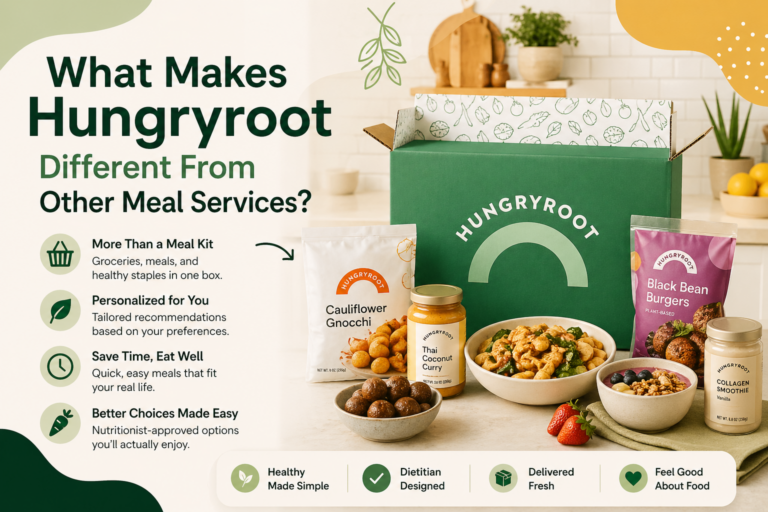
Hungryroot is one of those services that does not slot neatly into the standard categories. It does not feel exactly like a traditional meal kit, and it does not feel exactly like a grocery delivery service either. It sits somewhere between the two, and that positioning turns out to be one of its most practical strengths. Understanding what that actually means in practice helps explain why so many people find it more useful than what they tried before.
It Does Not Try to Script Every Meal
Most meal kit services are built around a fairly predictable structure. You choose your meals for the week, a box arrives with the exact ingredients for each one, and you cook them according to the recipe cards provided. That model works well for people who enjoy following structured recipes and planning their dinners in advance.
But not everyone eats that way.
Hungryroot approaches food differently. Rather than sending a fixed set of ingredients tied to specific recipes, it delivers food that can be used flexibly across different meals and moments throughout the week. Something that works as a dinner one night might also work as a quick lunch the next day. Items that arrive together are not necessarily locked into one predetermined combination.
That freedom might seem like a small thing, but it changes the whole feel of the experience. It stops feeling like a weekly assignment and starts feeling like genuine support for the way people actually eat.
It Thinks Beyond Dinner
One of the more telling differences with Hungryroot is that it does not treat dinner as the only meal worth caring about. Most meal services are almost entirely focused on the evening meal. Everything is designed around what you will cook tonight, and the rest of your day is left to figure out on its own.
Hungryroot seems to take a wider view. It recognizes that people need to eat throughout the day, not just at dinnertime, and that the friction around food is not limited to one moment. Breakfast, lunch, snacks, and quick weekday meals are all part of the picture.
That broader thinking is what makes it feel more like a full food solution than a narrow product. For users who want help simplifying their entire week around eating, not just one meal per day, that difference is significant.
The Convenience Actually Holds Up in Real Life
Convenience is one of the most overused words in the meal delivery category. Almost every service describes itself as convenient. But convenience that requires significant cooking time, complex preparation, or careful planning on the user’s part is not really delivering on that promise. It is just shifting the effort from one place to another.
Hungryroot tends to deliver on convenience in a more honest way. The foods it offers are generally designed to come together quickly. Meals do not require long preparation windows or advanced cooking skills. The whole experience is built around the idea that real life is often busy, unpredictable, and short on time and energy.
That realistic approach is one of the clearest ways it separates itself from services that look convenient on paper but feel effortful in practice. When convenience actually matches the pace of someone’s life, it becomes something they will keep using rather than abandon after a few weeks.
It Feels More Personal Than Most Alternatives
Personalization is something a lot of meal services claim to offer. Usually what that means in practice is a set of dietary filters, a preference checklist, or the ability to swap out one recipe for another. That is useful, but it is a fairly shallow version of what personalization can actually look like.
Hungryroot goes further than that. It tries to understand how someone actually eats, what their goals are, and what kinds of food genuinely fit their routine. The result is a service that can feel noticeably more tailored than the average meal kit, even for users with specific dietary preferences or particular goals around health and nutrition.
That matters because personalization is not just a feature people appreciate. It is often the reason they stay. A service that feels like it was chosen for you, rather than one you are trying to adapt yourself to, is a service that is much easier to keep using over time.
It Works When Plans Change
One of the quiet frustrations with traditional meal kits is that they work best when your week goes according to plan. If you are too tired to cook on Tuesday, the ingredients for Tuesday’s meal sit unused. If plans change and you end up eating out, the box keeps arriving whether you need it or not. The rigidity that makes the model feel organized can also make it feel limiting.
Hungryroot handles that kind of unpredictability better. Because the food it delivers is more flexible by design, a change in plans does not automatically mean waste or frustration. Items can be used on a different day, in a different way, or combined differently depending on what is actually needed that week.
Real life rarely follows a tidy schedule. A service that bends to fit that reality rather than expecting users to organize their lives around it will always feel more practical than one that does not.
The Value Goes Deeper Than Price
When people compare meal services, price tends to be the first thing they look at. That makes sense. Cost matters. But value and price are not the same thing, and the difference between them is often where the real comparison lies.
The value Hungryroot offers is not just in the food itself. It is in what the service removes from someone’s week. Fewer decisions about what to eat. Less time spent at the grocery store. Fewer evenings trying to figure out what to cook with whatever happens to be in the fridge. Less mental energy spent on the routine logistics of feeding yourself and your household.
When a service reduces that kind of friction consistently, it becomes genuinely worth what it costs. That is a different kind of value from simply offering a competitive price, and it tends to hold up better over time.
It Fits People Who Want Guidance Without a Rigid System
There is a particular kind of person Hungryroot seems to connect with most naturally. Not someone who wants every meal decided for them, but also not someone who wants to start from scratch every night. Someone who wants a little structure without feeling controlled by it. Someone who wants healthier and more intentional food choices without turning meal planning into a second job.
That middle ground is where Hungryroot lives. It offers enough guidance to make the week easier without enough rigidity to make it feel constraining. For people who have tried traditional meal kits and found them too structured, or who have tried going it alone and found it too chaotic, Hungryroot can feel like a more natural fit.
Finding that balance is genuinely difficult for a food service to achieve. The fact that Hungryroot manages it is one of the more honest reasons it stands out.
The Real Difference Is How It Fits Into Life
Most meal services ask users to organize their eating habits around the service. Hungryroot seems more interested in doing the opposite. It tries to fit around the way people actually live, eat, and manage their time.
That difference in approach shows up in almost everything about the experience. The flexibility of the food. The broader focus beyond just dinner. The practical convenience that holds up under real conditions. The personalization that feels meaningful rather than cosmetic.
For people who have felt let down by meal services that promised one thing and delivered another, Hungryroot offers something that feels more grounded and more genuinely useful. Not because it is perfect, but because it is built around how people actually eat rather than how a service wishes they would.
A Few Quick Answers
Is Hungryroot a meal kit or a grocery service? It sits between the two. It offers food that can be used for quick meals but also functions more like a personalized grocery delivery, giving users more flexibility than a typical meal kit.
Does it work for people who do not enjoy cooking? Yes. Many of the foods are designed to be quick and easy to prepare, making it practical for people who want good food without spending a lot of time in the kitchen.
Can it work for specific dietary preferences? Hungryroot is known for taking dietary preferences seriously. The service is built to adapt to different eating goals and food preferences in a more meaningful way than most alternatives.
Is it more expensive than cooking at home? It depends on how you factor in time, convenience, and reduced food waste. For many users the overall value feels reasonable when those factors are taken into account.
Who does it work best for? People who want a more flexible, personalized food service that fits around real life rather than requiring them to reorganize their routine around a rigid weekly plan.